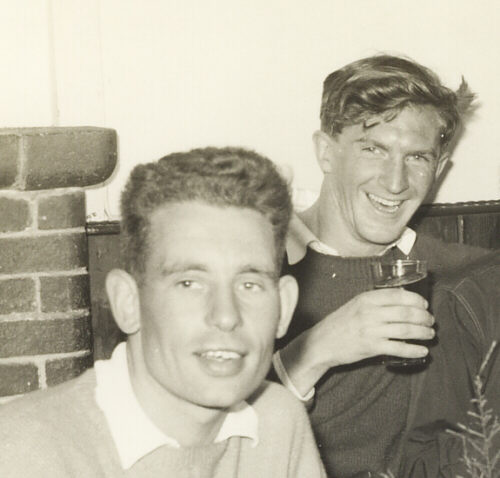
by GUY BELLAMY
|
The boy who sat in the corner of my class
at His sloping figure was never seen to
hurry or exert itself. His only consolation was a violin, which he seemed to
carry everywhere. His devotion to this instrument did not endear him to his
fellow pupils; when Pat Chandler played his violin, rooms emptied, dogs
howled and birds abandoned trees. But he could play any tune you named
without reference to the music – pausing only to recommend Gustav Holst’s The
Planets to anyone who would listen. While other boys achieved heroic status
on the football and cricket pitches, or kept their amusing assignations with
Bill Wickens in the gym, music was all that Pat had. But then – after four years of
introspective hibernation – the miracles began. In his fifth year at the
school a series of hospital examinations and tests produced the surprising
news that he no longer had a weak heart. He was normal. His heart was fine. He arrived at school next day with an
uncharacteristic grin: horizons were about to open up for him, and he was
going to make sure that they did. Specifically, after a lifetime of watching
miserably as other boys enjoyed the rewards of sport, he could now take part
himself. He was desperate to do so, but at 16 it was a little late to develop
the necessary skills at football, or master the finer points of cricket. Pat,
nudged by student optimism, made a brave decision. There was one sport he
could take up tomorrow without any experience at all - running. Some of us laughed at this. He didn’t
look like a runner. He didn’t even look like a runner when he ran. But run he
soon did. He ran round the sports field on his own, liberated unexpectedly
from the static life of an invalid. These lonely trials convinced him that he
was a distance man; the sprint wasn’t his forte. When school sports arrived,
he entered, to widespread amusement, for the mile. As The Farnhamian of June 1999
reveals on page 24, the winner of the mile in 1951 was P.R.Chandler. It is impossible to describe at this
distance the shock that his victory caused. The boys then at school couldn’t
have been more surprised if the gymnasium had been turned into a strip club.
But before people had recovered from this bombshell, an even bigger miracle
occurred. As school champion, Pat Chandler was sent
to the Surrey schools finals at Pat ignored the acclaim that fell on his
head and settled down to the unwelcome challenge of O-Levels. But he had one
more target in his sights: the school cross-country. This three-and –a-half
mile ordeal was the preserve of Mick Doyle who had won the previous year with
laughable ease and was so comprehensive a sportsman that he won his weight at
boxing during a respite from football and cricket. One day after school we timed Pat as he
ran round the course. It took him 20 minutes and 25 seconds. The time
depressed him. “I thought I had done it much faster than that,” he said, “but
with five weeks’ training I should win.” His confidence seemed absurd – but
the fact was that he had never lost a race! When the big day arrived on November 1, I
was corner boy at the bottom of “It was the bloodiest piece of running I
have ever done,” he informed his growing fan club. “ But I had the right
tactics.” These tactics, apparently, were not overly sophisticated and seemed
to involve no more than running like a gazelle from the start in the hope,
dramatically realised, of shaking off the rest. There was one more surprise in store: Pat
Chandler’s time was 18 minutes 58 seconds, which beat the school record by 18
seconds.
Thirty-five years later, on a snowy
evening in March 1986, Pat Chandler reappeared at the Hen and Chicken
at Froyle to which four men who were in Mike Foster’s very first class had
invited their old teacher for dinner. It emerged over the wine that Pat, who
lived in However, when I had finished this article
I tried to get in touch with him, to find out what he had to say about that
amazing summer. Sadly, his son Paul, aged 23 told me that Pat had died in
1998 at the age of 64. He had died after a second heart bypass operation. |
|
|
|
|